A study presented by Edison Next and Boston Consulting Group at Palazzo Edison argues that industrial districts could become a practical platform for decarbonizing process heat in Italy. The research states that more than 60% of the country’s industrial energy consumption is used to produce thermal energy, and that more than 90% of this demand is currently covered by fossil fuels. In non-metallic minerals, including cement, ceramics and glass, heat accounts for more than 80% of sector energy use, while in food, chemicals, metals and paper the share ranges from 55% to 70%.
According to the study, alternative technologies matched to different process-temperature requirements, including biomass, geothermal energy and carbon capture and storage, could deliver savings of up to 30% on final heat costs in scenarios with high gas and CO2 prices. The estimated environmental benefit is a reduction of more than 200 kg of CO2 per thermal MWh. The report’s main industrial point is that clusters of nearby companies, concentrated energy demand and local know-how can make shared investments viable where a single plant might struggle to justify them.
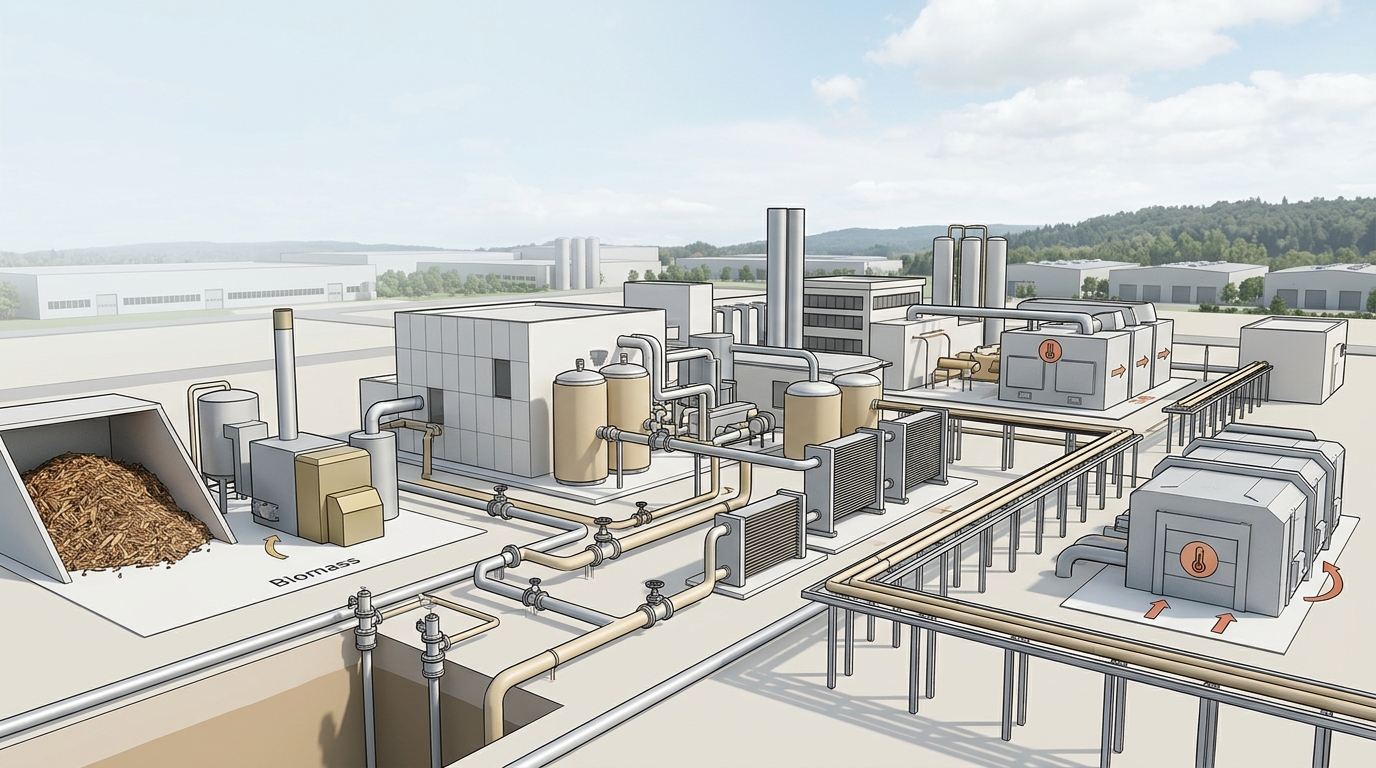
The analysis focuses on three technologies and their overlap with the geography of Italian industrial districts. It notes that Istat counts more than 140 districts, with over 25 involving some of the most energy-intensive industries. For biomass, the study estimates that feedstock from forest maintenance and agricultural pruning corresponds to about 4.5 billion cubic meters of natural gas equivalent, described as more than one-third of Italian industry’s gas demand. Potential applications mentioned include lower-temperature phases in Emilia-Romagna’s ceramic district, as well as chemical, paper and food sectors in several regions.
For geothermal energy, the study says Italy holds around 90% of installed geothermal power capacity in the European Union. It puts current geothermal heat output at about 0.2 billion cubic meters of natural gas equivalent across all uses, with a maximum potential of about 3-4 billion cubic meters equivalent for industrial consumption compatible with available temperatures. The most relevant areas are identified along the Tyrrhenian side of the country and across many low- and medium-enthalpy zones, with possible use cases in chemicals, paper and food processing.
CCS is presented as most relevant for sectors with concentrated CO2 emissions or process emissions, such as cement, and for combustion streams where the input material cannot be substituted, such as waste incineration. The study describes the Ravenna site as a strategic asset, with storage capacity of more than 500 million tonnes, potentially reachable from Po Valley districts by pipeline and from some coastal districts by ship. Recommended actions include linking projects to existing or developing infrastructure, aggregating district-wide demand, involving supply chains in public funding calls and building local competence hubs.
In the same material, Edison Next also highlights operating examples. The company says it is active in 37 municipalities through 40 district-heating networks, where 60% of heat generation comes from woody biomass. For industry, it points to Michelin Italiana’s Cuneo plant, where an integrated system including a 23 MWe trigeneration unit, a biomass boiler and photovoltaic plants allows the site, according to the company, to self-produce 97% of the energy it needs, with about 16% coming from renewable sources. The case is presented as an example of combining energy efficiency, renewable energy and emissions-reduction targets.