Ulanqab, in Inner Mongolia, illustrates how electricity pricing is becoming a core industrial variable for artificial intelligence infrastructure. In the source material cited from BBC and Caixin, a company in Suzhou training or querying AI models is said to pay the equivalent of €35-45/MWh for server power, while Italy’s wholesale single national price closed October 2026 at €231/MWh. In that setting, competitive advantage depends not only on access to chips, but also on available megawatts, construction speed and operating cost.
According to Caixin as cited in the material, Ulanqab had 84 projects by the end of 2025, backed by more than RMB 500 billion in investment, and 81 of them were intelligent computing centers. The companies named as users include Huawei, ByteDance, DeepSeek, Alibaba Cloud and Apple. In the first half of 2026, the city’s data services consumed 4 billion kWh, up 85.2% year on year. Alibaba Cloud, which entered in 2020 with the first campus, is described as operating nearly half of the city’s data centers today.
The hub’s economics are supported by site conditions as well as tariffs. Caixin estimates that a 1 GW campus consumes about 8.8 billion kWh per year and, at power prices of RMB 0.30-0.35/kWh, can save as much as RMB 5 billion annually versus Zhangjiakou. Climate also matters: an average annual temperature of 4.3°C, dry air and altitude close to 1,500 meters improve opportunities for natural cooling. At the same time, four milliseconds of latency to Beijing allows distance-tolerant workloads, especially model training, while inference remains closer to coastal demand centers.
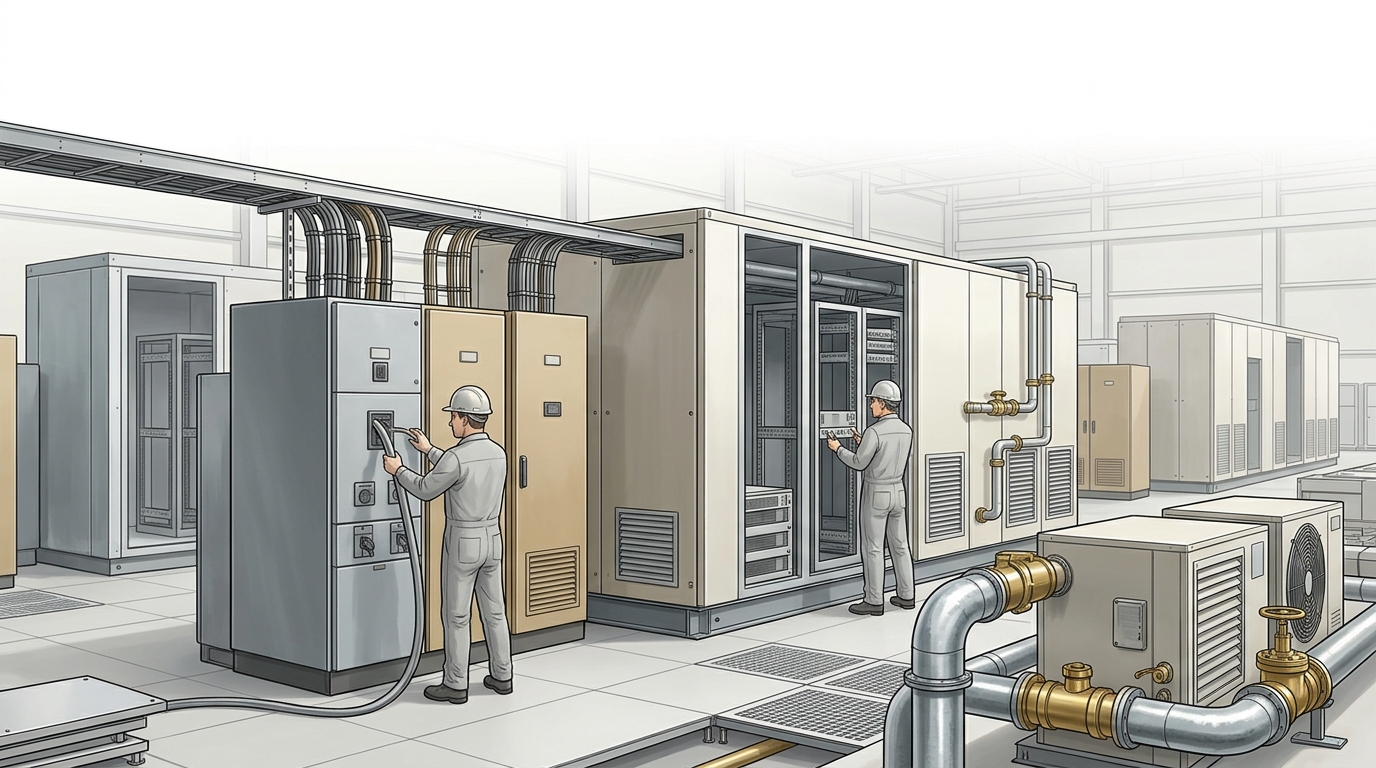
Build time is the second major lever. The data cited from Caixin puts traditional data center delivery at 6-12 months in China, 12-24 months in the United States and up to 30 months in Europe. In Ulanqab’s modular format, delivery is reported at 100 days, with total project costs reduced by more than 10%. That matters for European suppliers as well: ABB presented a modular offer in June with timelines shortened by 30%, while Schneider Electric, Vertiv and Italy’s ecosystem of switchboard, UPS and cooling suppliers are active in the same competitive space.
For Italy, the comparison is mainly about energy and infrastructure readiness. As of 21 August, Terna counted 531 grid-connection requests for new data centers totaling more than 95 GW, including 46 GW in Lombardy. Yet only eight facilities were connected as dedicated loads, three of them entering service in 2026. In spring, Terna’s Mauro Caprabianca estimated a realistic level of 1.5-2 GW by 2030. Meanwhile, according to GME data cited in the material, the Italian PUN rose from €114-143/MWh in the first five months of 2026 to €157 in July, €208 in September and €231 in October. The article estimates that a 100 MW campus running at full load would consume about 876 GWh a year, costing roughly €200 million at October’s PUN versus €35-40 million in Ulanqab.
For European manufacturing, the issue extends beyond data center construction. If compute is purchased as a service, the power-cost gap feeds into the price of AI used for design, simulation, automation and day-to-day industrial workflows. For Italian equipment suppliers, the most immediate risk may be in third markets, where competition can shift toward complete modular blocks delivered quickly and at lower turnkey cost.