UC Berkeley and NVIDIA have released open-source tools for a robot-programming approach based on AI agents, aiming to let coordinated agents write, simulate, and refine readable robot programs. Presented this week at CoRL 2026 in Austin, the work proposes a development loop in which code generation is followed by repeated testing, failure analysis, and revision in simulation rather than a single-pass output.
The approach combines two main components. Graph-as-Policy, or GaP, is a modular framework that divides a task into functions such as perception, grasp planning, and collision-free motion. Variational Automation Benchmark for Agentic Robotics, or VABAR, is a benchmark built around six tasks: tool sorting, tool hanging, gear meshing, syringe packing, cable insertion, and cable routing. It runs on Isaac Lab-Arena and Newton, with standardized variations, difficulty tiers, and success metrics for comparing results.
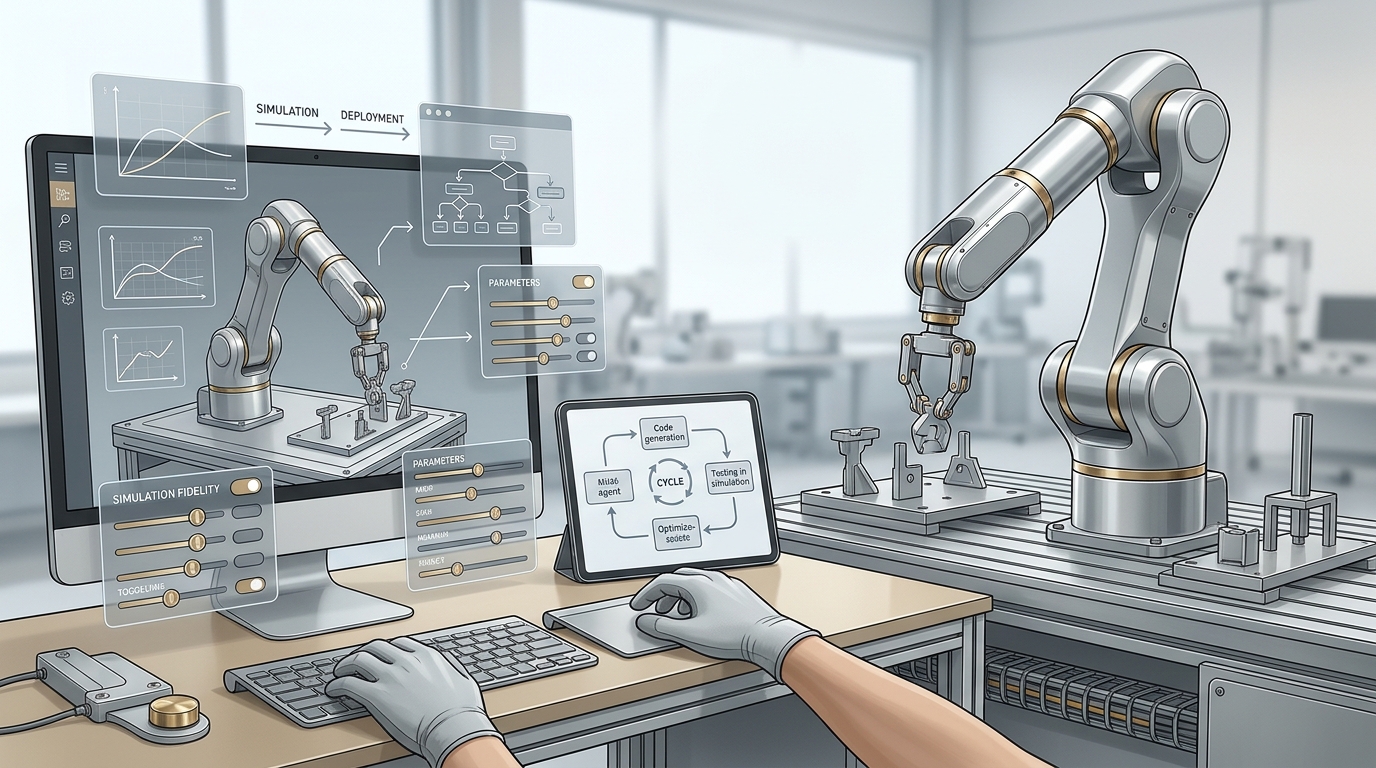
Simulation is presented as the critical enabler. Berkeley selected the open-source Newton physics engine, but the material describes it as difficult to use because it exposes hundreds of parameters. To make that layer more practical, graduate student Eric Chen developed RoboSimStudio, an interface intended to simplify tuning and scene setup. Ken Goldberg told The Robot Report that when a model identified as GPT-6 Astra was given a video and the tool, it produced a Newton simulation closely matching the video in about an hour through iterative trial and error.
In Berkeley's workflow, agents write robot code, test it in simulation, observe failures, and revise the program. The GaP graph structure allows different nodes, such as perception, grasping, and motion planning, to be handled by separate agents working in parallel. The team also says the graph is equivalent to a ROS graph and can be converted to ROS 2. The resulting output is Python that calls existing vendor modules for low-level drive control, so the method is described as working with current robot controllers rather than replacing them.
The report also cites early industry interest. Bosch is evaluating agentic robotics for a range of industrial automation scenarios, while Ambi Robotics says it has used the method to turn production data into robot-behavior updates that increased throughput across its U.S. fleet. Those statements come from the companies involved, and the source does not provide quantitative performance figures. For manufacturing users, the main takeaway is that more accessible simulation, shared benchmarks, and interpretable code could reduce late-stage software bottlenecks in robotic cells and improve verification before production rollout.