Hurco used IMTS to show two related developments: a redesigned machine control and the use of artificial intelligence to reduce programming time for complex five-axis parts. The demonstration focused on components with compound-angle holes, a type of work that often requires manual calculation of geometric transforms and can take hours to program by hand.
The company said the new control was designed around the operator. Each user logs in through an individual account, allowing the machine to restore personal layouts and preferences automatically. Hurco also highlighted customizable placement of favorite buttons, user-specific access restrictions for certain functions, and flexible screen splits between the program view and graphics.
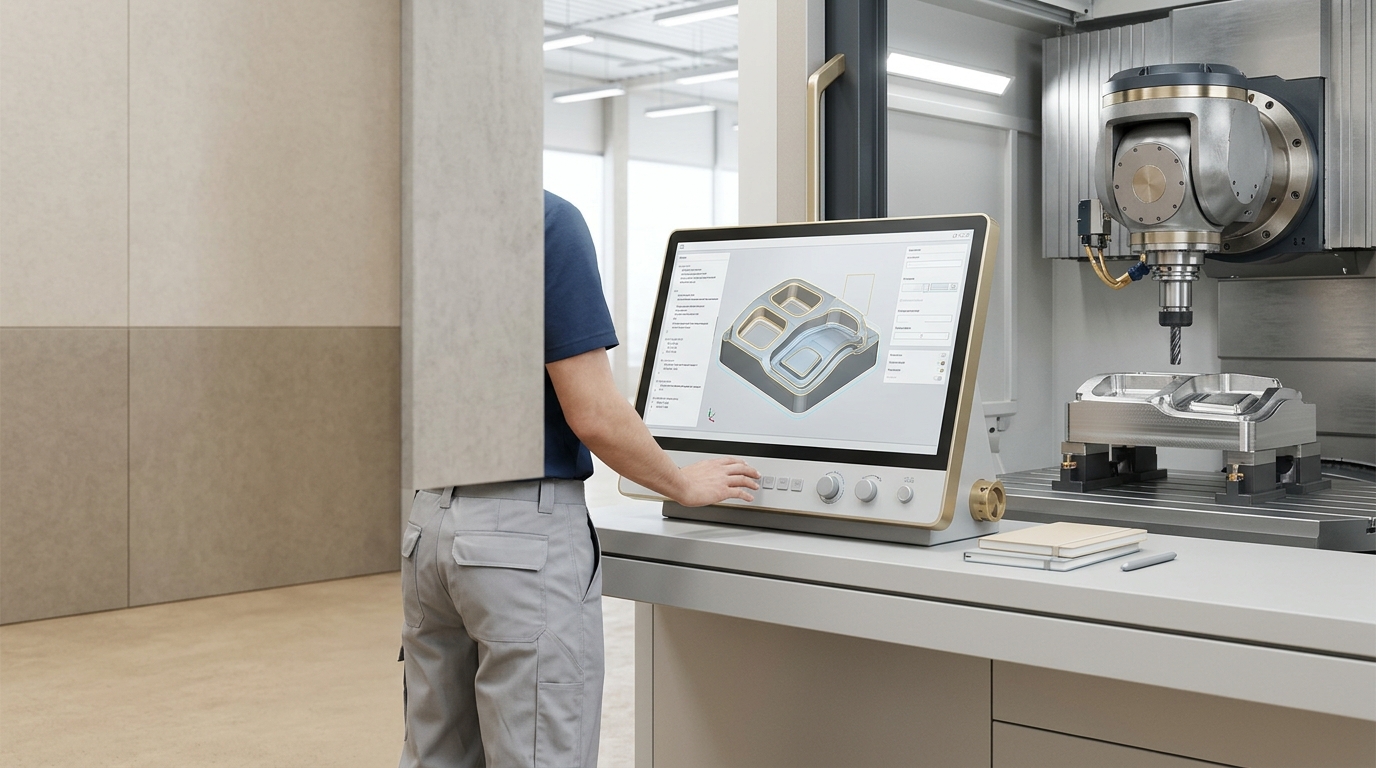
On the hardware side, the control uses a curved screen intended to keep the operator’s attention centered on a single viewing area. A physical keyboard tray can be tucked away when not in use. The stated aim is to make key operating information easier to access without forcing users to search through multiple screens or controls.
The main software demonstration centered on AI-based feature recognition inside Hurco’s conversational programming system. The company said the model was trained specifically on its own conversational programming method rather than as a general-purpose model. After a 3D solid is imported, the software automatically identifies the features to be machined and highlights them for review. The user can then inspect, edit or remove any recognized feature before the final program is generated.
Hurco said a five-axis part with compound-angle holes would typically require an hour or more to hand-program. Using solid import, that time could fall to about 15 to 30 minutes, while the AI-assisted workflow shown at the event was described as nearly instant. The company also said the process allows errors to be identified and corrected before cutting begins.
Taken together, the demonstration points to a programming workflow in which less time is spent defining each feature and transform manually, and more time is devoted to validating software-generated output. For shops handling complex geometries, that could support faster preparation and more consistent programming practices while keeping final review in the hands of the user.