At DMG MORI Innovation Days 2026, held at the company’s technology center in Hoffman Estates, Illinois, the machine tool builder used its annual event to show how its additive manufacturing strategy is broadening. The year also marks 10 years of the company’s directed energy deposition Lasertec hybrid platform, a period in which the portfolio has expanded to include laser powder bed fusion systems in the Lasertec SLM line, industry partnerships and some additive machine construction in the United States.
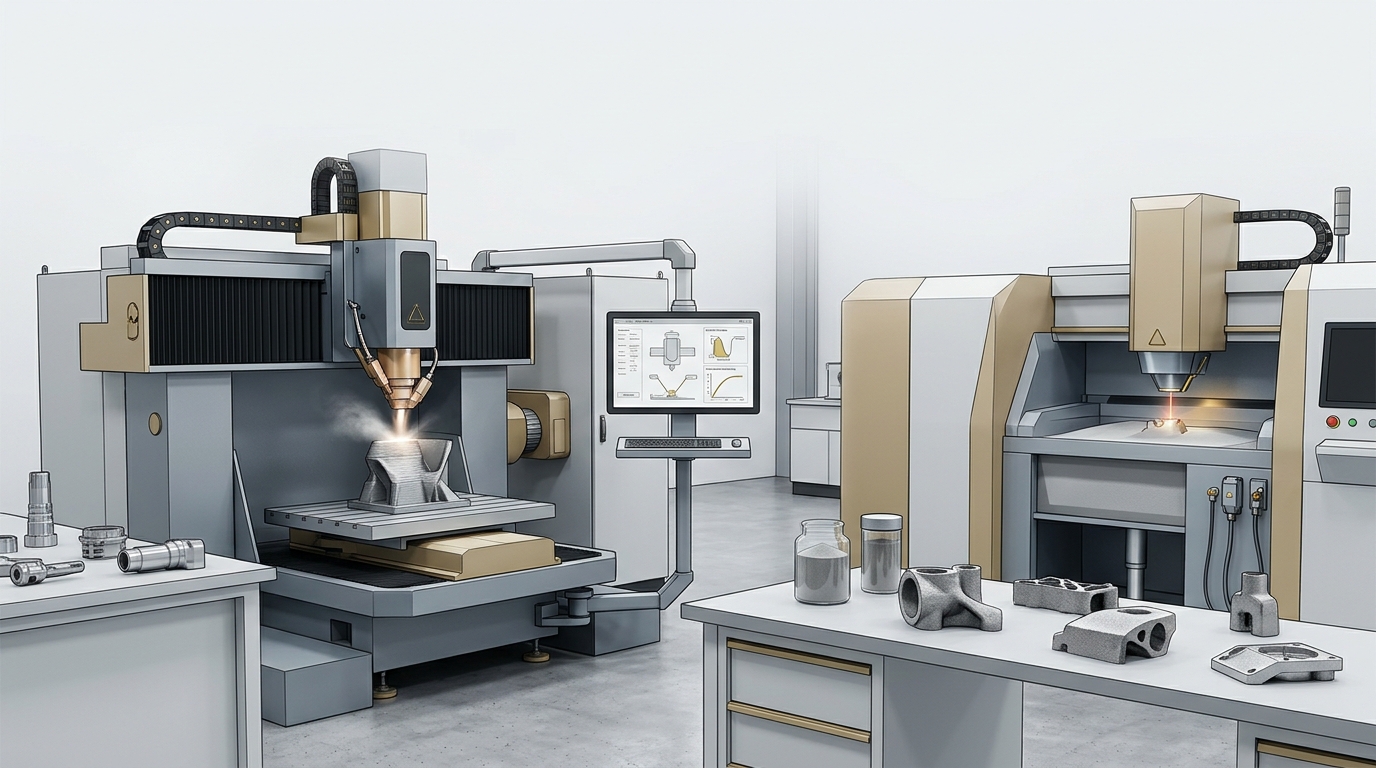
A central development is the push for higher DED productivity. DMG MORI said the second-generation Lasertec 65 DED hybrid, introduced earlier this year, features an updated base machine structure along with a higher-power laser source and a more efficient nozzle system. According to the company, those hardware changes are intended to support faster build rates and lower workpiece cost. On the software side, the platform also adds a more intelligent measurement system to track build progress.
Monitoring is a second focus area. On the Lasertec 65 DED hybrid second-generation platform, a meltpool camera mounted on the laser head is used to monitor the pixels representing metal in the liquid state and to check tool center point deviation. DMG MORI linked this to a broader package of process oversight that combines precise feed control, laser power control, temperature control and monitoring across multiple systems.
That expanded sensing is paired with adaptive control. Based on process feedback, the DED platform can now be programmed to adjust itself. Power and speed can adapt automatically, while temperature changes can be made by adjusting laser power and the laser’s distance from the meltpool. A fan can also be mounted on the spindle to cool parts when needed. Users can set condition “guards,” receive warnings when variables drift from the target window and stop the machine if temperature or another metric exceeds the selected limit.
For LPBF, DMG MORI is offering two different Lasertec SLM machines. The German-built Lasertec 30 SLM 3rd generation made its U.S. premiere during Innovation Days, while the Lasertec 30 SLM US is built at the company’s Davis, California, facility. The U.S. version is positioned as a smaller single-laser entry point with a reduced footprint and build volume, partly because it does not include integrated functions such as sieving found on the larger machine. The design is intended to let customers select options such as a heated build plate, monitoring or internal vacuum while also supporting serviceability. DMG MORI said the machine uses cast components, a magna-scale encoder with about 6 nanometers of tolerance, a recoater that combines a carbon fiber brush with an electrode, and beam shaping that allows a single laser to handle both larger spot sizes for productivity and smaller spot sizes for finer features. The company also said it is working with Phase3D on in situ measurement.
The company is also increasing its internal use of printed parts in its own equipment, citing examples such as the cyclone in the Lasertec 30 SLM US, the drawbar in speedMASTER spindles, a robot end effector for the Robo2Go system and a heat exchanger on the Lasertec 30 SLM 3rd Gen. In addition, DMG MORI Federal Services Inc. announced plans in 2026 to open a new facility on Chicago’s Goose Island to support the U.S. Department of Energy, Department of Defense and other partners and customers with 3D printed parts. The site is planned to include five or six 3D printers, plus heat treatment and metal removal capability, for both qualification work and production.