The humanoid robot market is becoming easier to map, but it remains highly fragmented in how products are actually sold and deployed. The review updated on November 3, 2026 identifies 12 models with some form of commercial availability, ranging from direct ordering to B2B project supply and rental or Robot-as-a-Service, alongside 16 more platforms that remain in pre-order, selective customer validation or development. For industrial users, the first filter is not the robot’s appearance but the task to be performed and what the supplier is truly offering.
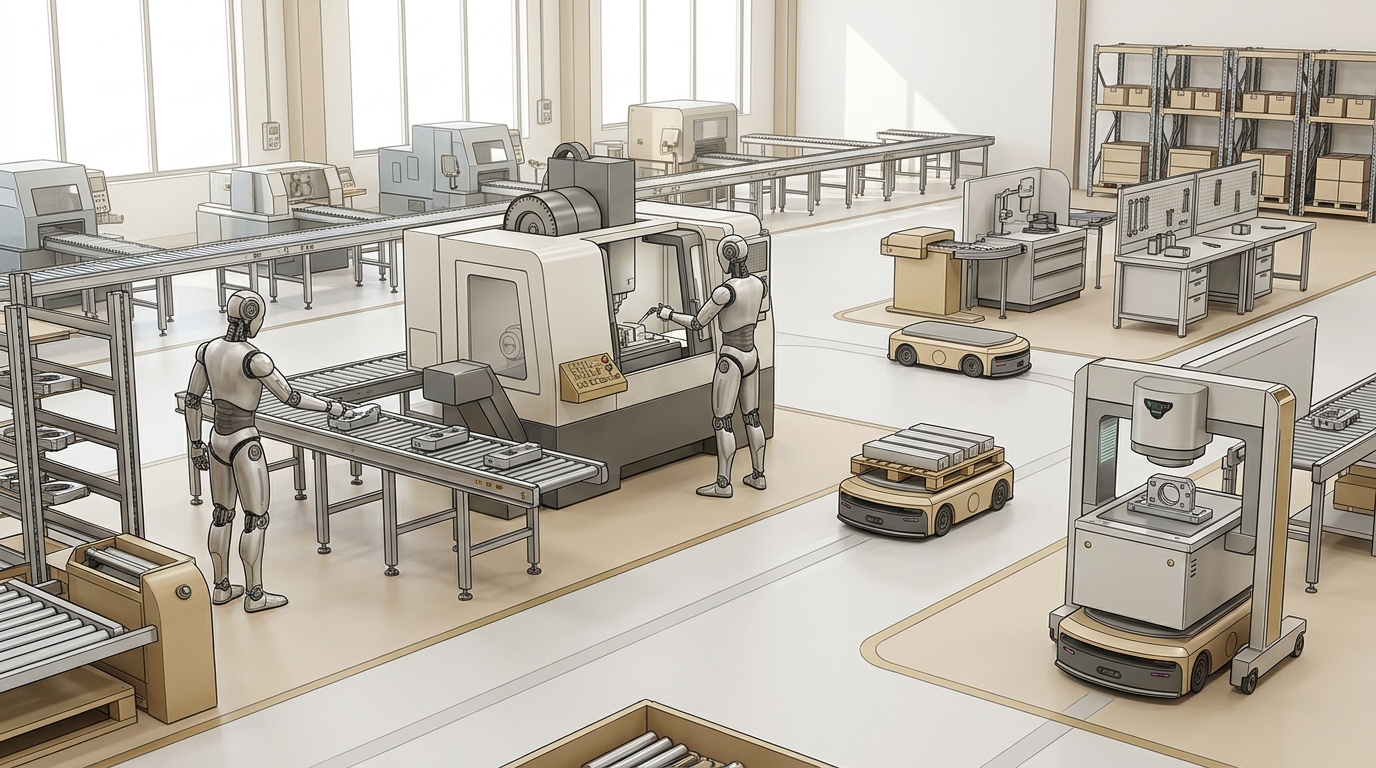
According to the source material, the rationale behind the humanoid format is straightforward: these robots are meant to work in spaces already designed for people, reaching existing stations, objects and interfaces. The most relevant industrial use cases include material handling, machine tending, quality inspection and component assembly. Still, turning those capabilities into repeatable production work depends on software, training, end effectors and process integration rather than on morphology alone.
Among the commercially accessible models, positioning varies widely. Unitree covers the lower entry range with R1 Air starting at $4,900 and R1 at $5,900, while G1 and H2 are presented as research and development platforms with starting prices of $13,500 and $29,900 respectively. In logistics, Agility Robotics’ Digit remains one of the more established commercial examples, using enterprise contracts and a RaaS model, while UBTECH Walker S2, AgiBot G2 and Oversonic RoBee are positioned around industrial or production-focused deployments delivered on a project basis.
The survey also includes platforms aimed more clearly at research, interaction and public-facing functions. Fourier’s GR-2 is described as a platform for locomotion, dexterity and AI-related robotics development, with availability also indicated through the Italian RBTX marketplace. Engineered Arts’ Ameca remains focused on dialogue, events, reception and conversational interface research. In DEEP Robotics’ case, the source reports the producer’s stated start of commercialization for DR02, but without public details on price, customer references or delivery timing.
The 16 platforms to watch include programs with selective access or commercial timelines that are not yet fully open, such as 1X NEO, Apptronik Apollo, Figure 03, Hexagon AEON, Boston Dynamics Atlas, Tesla Optimus and XPENG IRON. In several cases, manufacturers refer to reservations, early access, pilot deployments or internal production rather than broad market availability. For buyers and production managers, that means humanoid comparisons should focus less on demonstration appeal and more on verifiable factors: actual configuration, support coverage, delivery conditions, service continuity and fit with the target process.