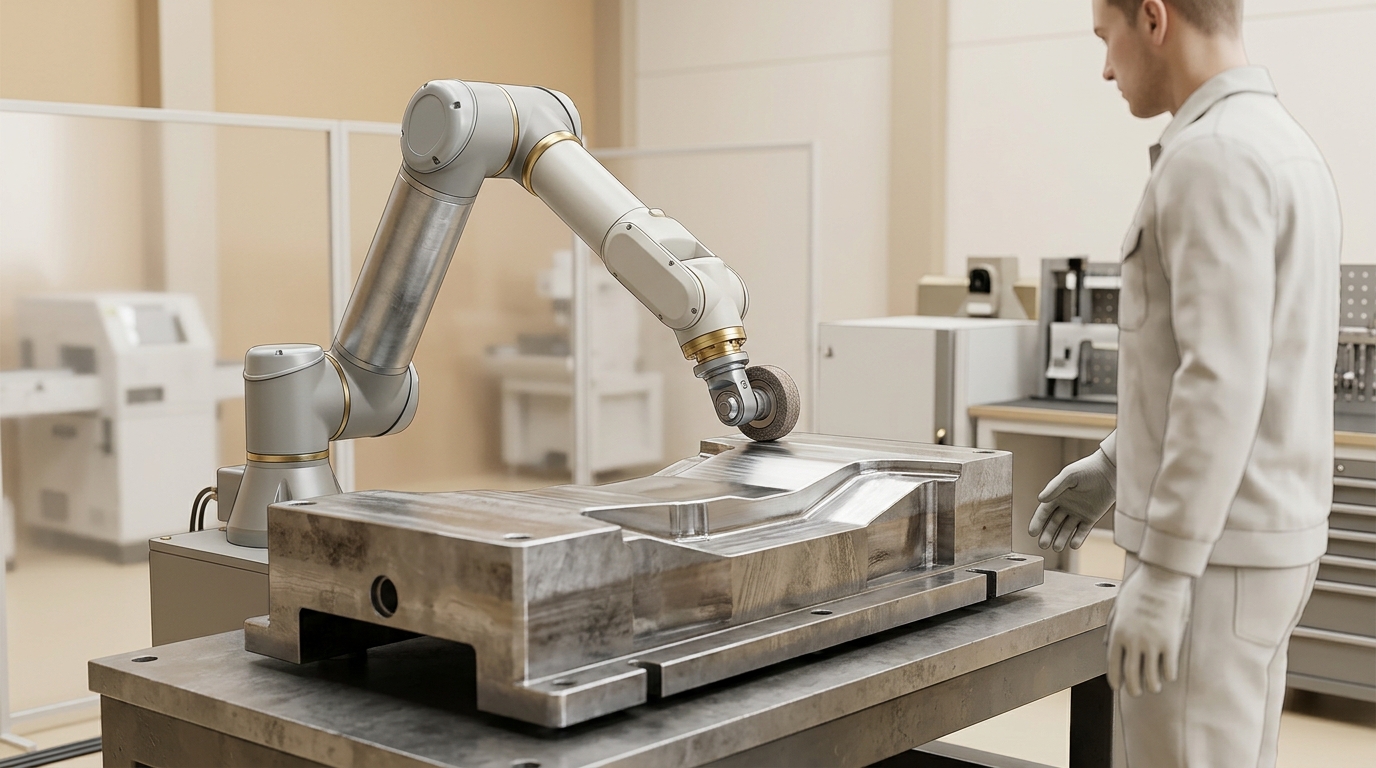
Surface finishing for press tools is still a manual operation today. Based on the available material, that final process step is now the focus of a development effort intended to introduce a robotic alternative.
The project brings together Hochschule München, BMW, Tebis and MRK Systeme. The source material does not provide technical details on the system, and it does not specify an industrialization timeline, process parameters or test results. It does, however, state that the partners are working on an automated method for the surface finishing of press tools.
In industrial terms, tool-surface finishing is a sensitive stage because it affects the functional quality of the tool and its readiness for production use. The fact that the work is still performed manually highlights both the importance of craft-level expertise and the challenge of standardizing operations that require precision, consistency and adaptation to complex tool geometry.
If developed to production maturity, an automated approach could help make this type of finishing more repeatable and less dependent on direct manual intervention. For toolmakers, specialist shops and end users in automotive and metal forming, the topic is relevant above all in relation to skills availability, quality consistency and the integration of robotics with process software.
The sources reviewed, however, only outline the basic scope of the initiative. They do not disclose information on robot cells, finishing tools, sensors, CAM strategies, cycle times or measured performance gains. For that reason, the item should be read as a report on an industrial research and development project rather than the launch of a market-proven solution.
Even so, it is notable that an academic institution, an automotive manufacturer and suppliers of software and automation systems are collaborating on a final process step that remains only lightly automated. At this stage, the key point is the attempt to hand over the last surface-finishing step on press tools to a robot.