For years, grinding and EDM were the default routes for machining materials above 45 HRC. In a feature published by Modern Machine Shop, Sam Thomason of Shibaura Machine argues that hard milling has advanced enough to become cost-competitive in the right applications, and in some cases may even lower overall production cost when the process is tightly controlled.
The discussion covers hardened steels as well as other difficult materials, including cemented carbide, glass, titanium and Inconel. Thomason says brittle materials are especially demanding because they tend to fracture rather than form a stable chip. As a result, hard milling should be approached with repeated cuts at less than one micron depth of cut, with roughly 70 nanometers cited as a preferred target for best results.
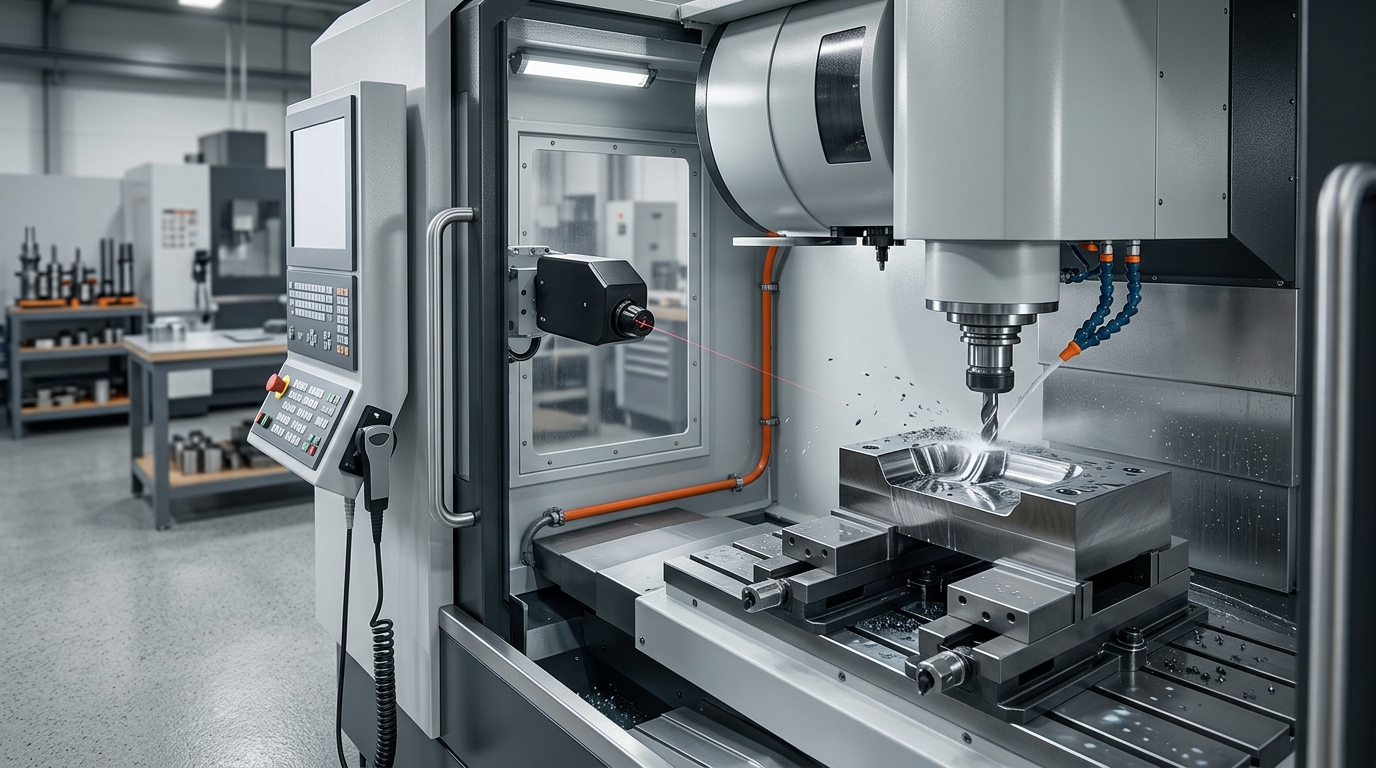
Holding that level of cut consistently depends on a highly repeatable machine and several supporting technologies. Thomason points to in-process tool gaging as a critical requirement, with optical measurement favored where possible because it can handle a wider range of tool diameters and geometries. He also recommends camera-based measurement of compatible workpieces during machining, reducing the need to remove a part for external CMM inspection and then return it to the machine for more operations. The measured data then needs to flow into the CNC so offsets can be applied automatically.
Machine dynamics are another focus. Thomason recommends aerostatic spindles over ball-bearing spindles to reduce vibration and runout at the very small scales involved in hard milling. In the same vein, linear motors are presented as preferable to ballscrews because they remove a source of mechanical friction and vibration while allowing nanometer-scale motion increments. Thermal stability is described as equally important, since even a few microns of size change caused by temperature can disrupt a sub-micron cut.
Shibaura links this process setup to measurable production gains. The article cites one test part that reportedly required 24 hours by EDM and 11 hours by hard milling. It also describes a customer case in which hand polishing on a mold was reduced from eight hours to 40 minutes after the milling process was optimized to produce a more uniform surface directly off the machine. These figures are attributed to the company.
At the same time, the source makes clear that hard milling is not a universal replacement for other processes. Sharp face corners, unusual angles and small internal pockets are described as better suited to EDM, while demanding flatness requirements may still favor grinding. The practical message is that shops should compare milling, grinding and EDM based on total process cost and part geometry, while recognizing that milling can offer an advantage when it removes upstream preparation and shortens the route to finished parts.