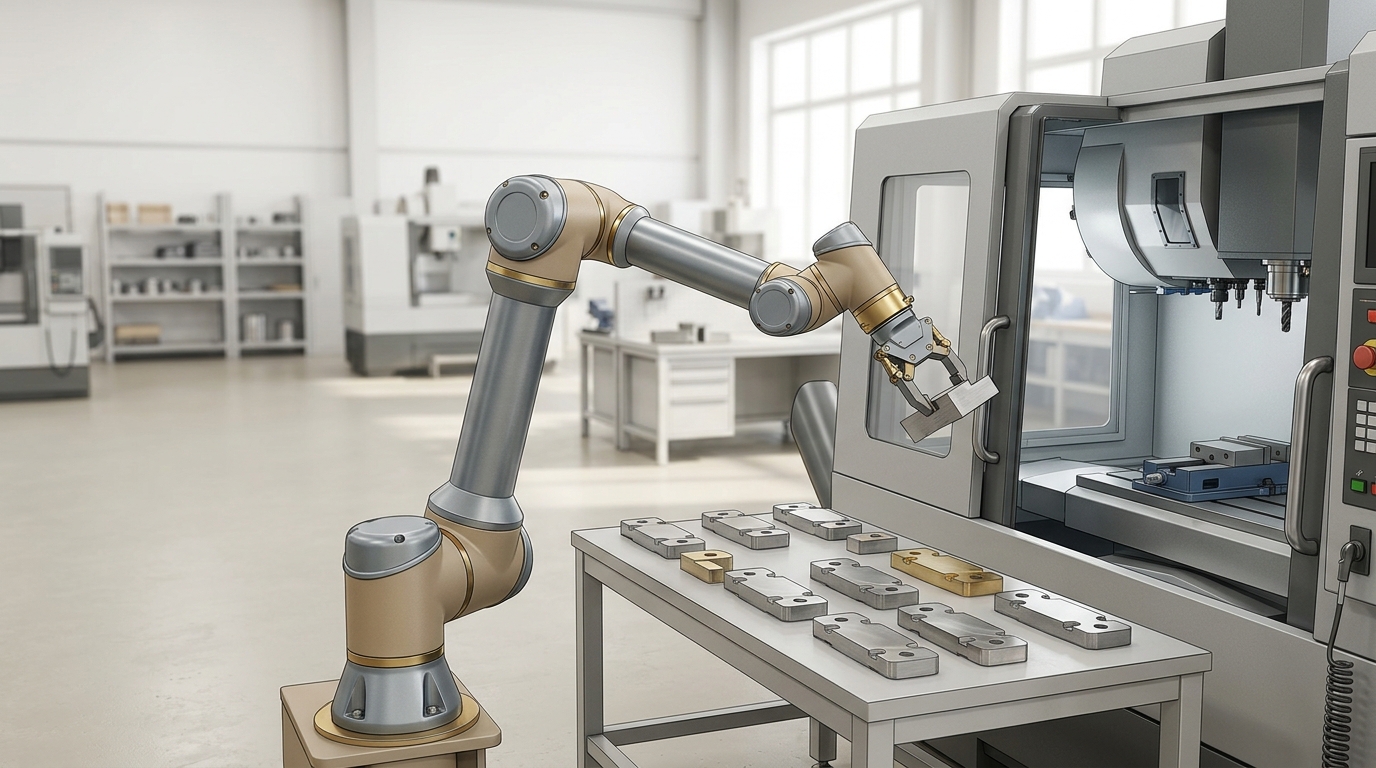
Productive Robotics has introduced OB7-AI, a new 7-axis collaborative robot aimed at CNC machine tending. The company unveiled the system at IMTS 2026, positioning it as the next step in the shift from execution-focused cobots toward more adaptive systems that combine AI functions with no-code operation.
The launch builds on Productive Robotics’ established zero-programming, teach-by-touch approach used across its OB7 range. According to the company, teaching a cobot job is already simple and only needs to be done once per task, but it still consumes operator time. OB7-AI is intended to recover some of that time by taking over more of the discovery and handling steps around the machine.
Based on the company’s description, the cobot automatically scans the machine work area to identify where items are located. Operators do not have to place blanks in exact positions on the table, provided there is enough room between parts for the gripper to reach them. After locating a blank, the robot opens the machine door, loads the part into the vise, closes the door and presses the start button.
To determine when machining is finished, OB7-AI reads the CNC screen. It then opens the door, unloads the finished part and repeats the sequence until the job is complete. Productive Robotics also says the system does not require AI training cycles for new parts or tasks, a claim that directly targets high-mix, low-volume environments common in job shops and contract manufacturing.
The company identifies automotive and CNC machining as the main markets for cobots using what it calls physical AI, while also pointing to potential use beyond factory settings, including laboratory research and healthcare. Productive Robotics says it designs, manufactures and services its collaborative robots, robotic MIG and laser welding systems, and accessories in the United States.
For manufacturers, the key issue is less the AI label itself than how these functions fit real production cells and mixed equipment fleets. If the stated capabilities translate reliably to shop-floor use, the combination of a 7-axis arm, no-programming interface and autonomous work-area awareness could expand collaborative automation options for CNC tending applications.