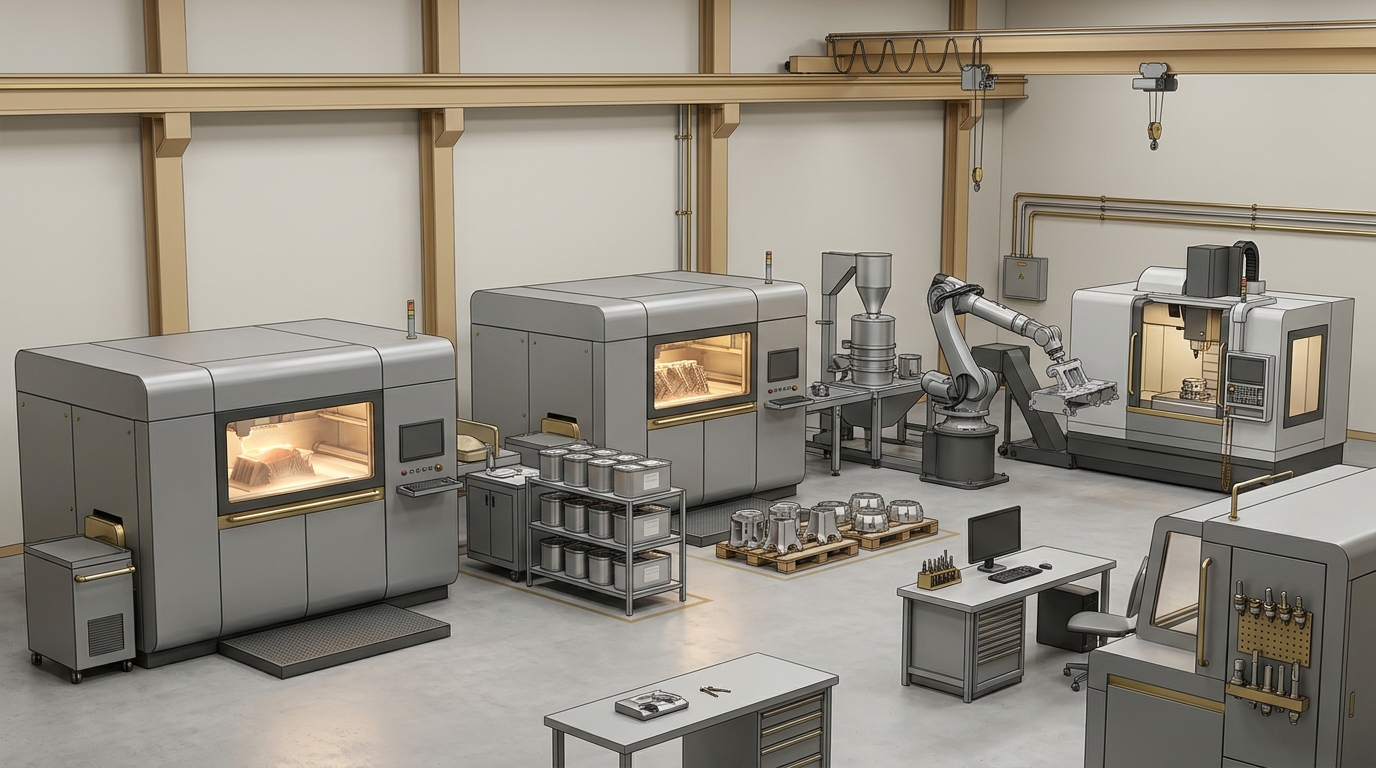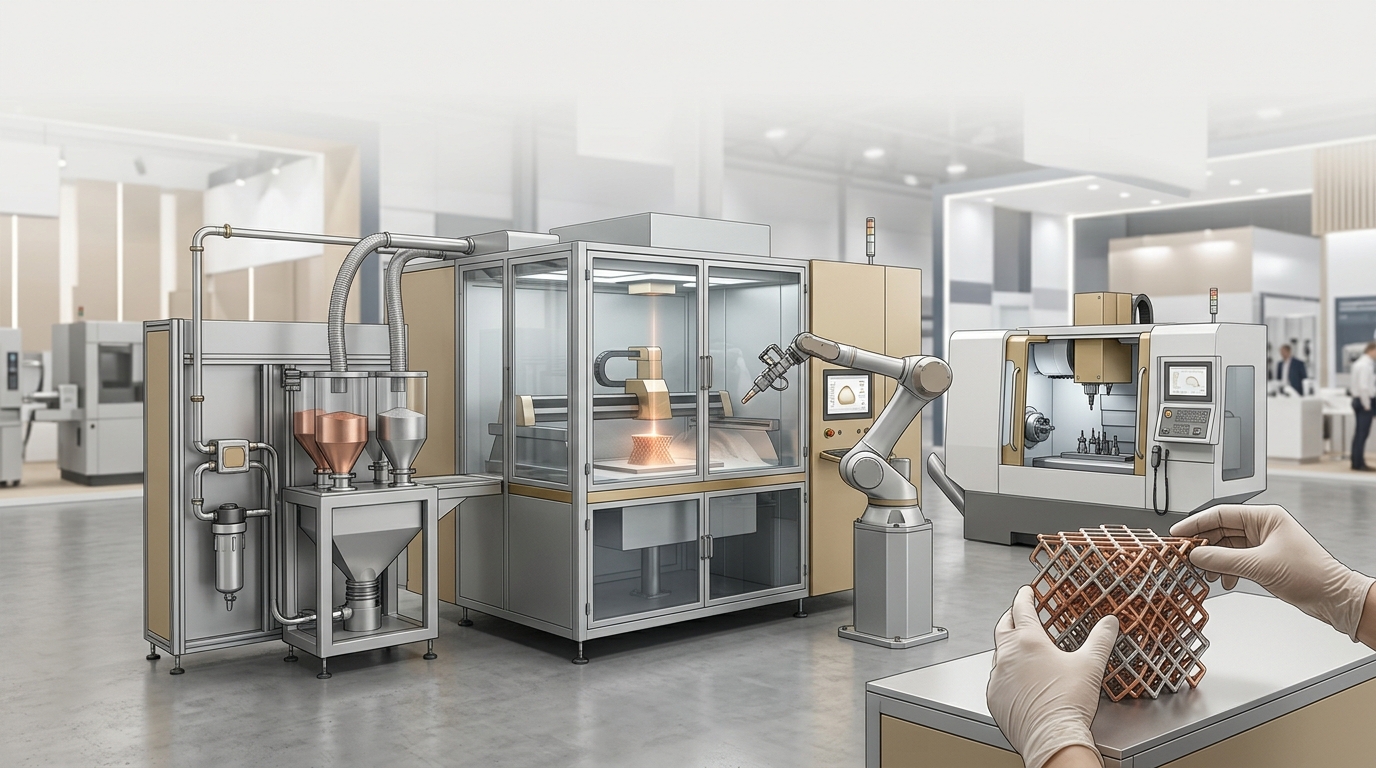
At IMTS 2026, additive manufacturing was framed less as a separate specialty and more as part of a broader production environment. The relocation of the Additive Sector to the South Building, next to the Metal Removal Sector, reinforced links with CNC machining, inspection, parts cleaning, robotics and software-driven manufacturing. Within that setting, one of the clearest show-floor developments was the way some technology suppliers are taking on more of the early production burden for customers.
Examples ranged across processes. Hermle highlighted parts made through its Metal Powder Application process, a hybrid approach the company also operates as a service for applications requiring multi-material builds and graded transitions. In laser powder bed fusion, Velo3D connected its new Livermore facility to both printer manufacturing and customer part production, positioning the model as a lower-investment path for users not ready to install machines in-house. EOS Additive Minds described an expansion from proof-of-concept and proof-of-process work into “proof-of-production,” while Formalloy pointed to growing demand for initial qualification support on new programs before production is transferred to the customer.
A second trend is the effort to get users printing faster. EOS introduced a powderless acceptance test for LPBF systems so scanners and lasers can be checked at delivery without handling material. Renishaw emphasized its Optical System Verification approach for the RenAM 500 series, using a 13-by-13 array of hemispheres to verify laser positioning across the bed and complete calibration in about 20 minutes. On the software side, HP presented a guided workflow for the MJF 1200 developed with Materialise, while Ursa Major described work with Dyndrite on a slicer intended to adapt a design to whichever LPBF machine will build it.
Robotics also remained a major theme, particularly in large-format additive manufacturing. Caracol showed its Heron AM platform for thermoplastic pellet extrusion using a six-axis Kuka robotic arm, together with extrusion heads that can be integrated into existing robotic cells. Rapid Fusion highlighted modular robotic systems such as Apollo and the PE320 pellet extruder, aimed at configurable installations and demanding materials. The common direction is toward AM cells that are more adaptable in motion, scale and process control.
Drone production stood out as one of the most visible application areas at the show. In the Emerging Technology Center, a manufacturing cell combining additive, machining and robotics was producing and flying one drone about every four minutes. HP identified drones as a growth area for both MJF and Metal Jet, while Impossible Objects used the event to show composite drone production with its CBAM 25 process, citing speeds up to 25 layers per minute and part strength up to 200 MPa. InfinitForm, meanwhile, previewed a tool under development to speed the design of fixed-wing drone structures.
Supply-chain localization was another recurring topic. Caracol, EOS, Xact Metal and Velo3D all emphasized U.S.-based production or sourcing in different ways, against a backdrop of supply-chain tensions and restrictions cited by Velo3D regarding Chinese-built equipment for government-funded additive work. At the same time, postprocessing continues to be treated as a bottleneck. Solukon’s SFM-AT350 and SPR-Pathfinder Pro were presented as a way to analyze internal channels from the print file and plan depowdering more predictably and repeatably.