AIST has reported a joint development with Sanno of a self-supporting composite membrane for hydrogen separation that combines a very thin palladium layer with a porous nickel support. The work addresses a central trade-off in palladium membranes: lowering the use of an expensive precious metal while retaining hydrogen permeability, gas sealing and the mechanical strength needed to withstand operating pressure differences.
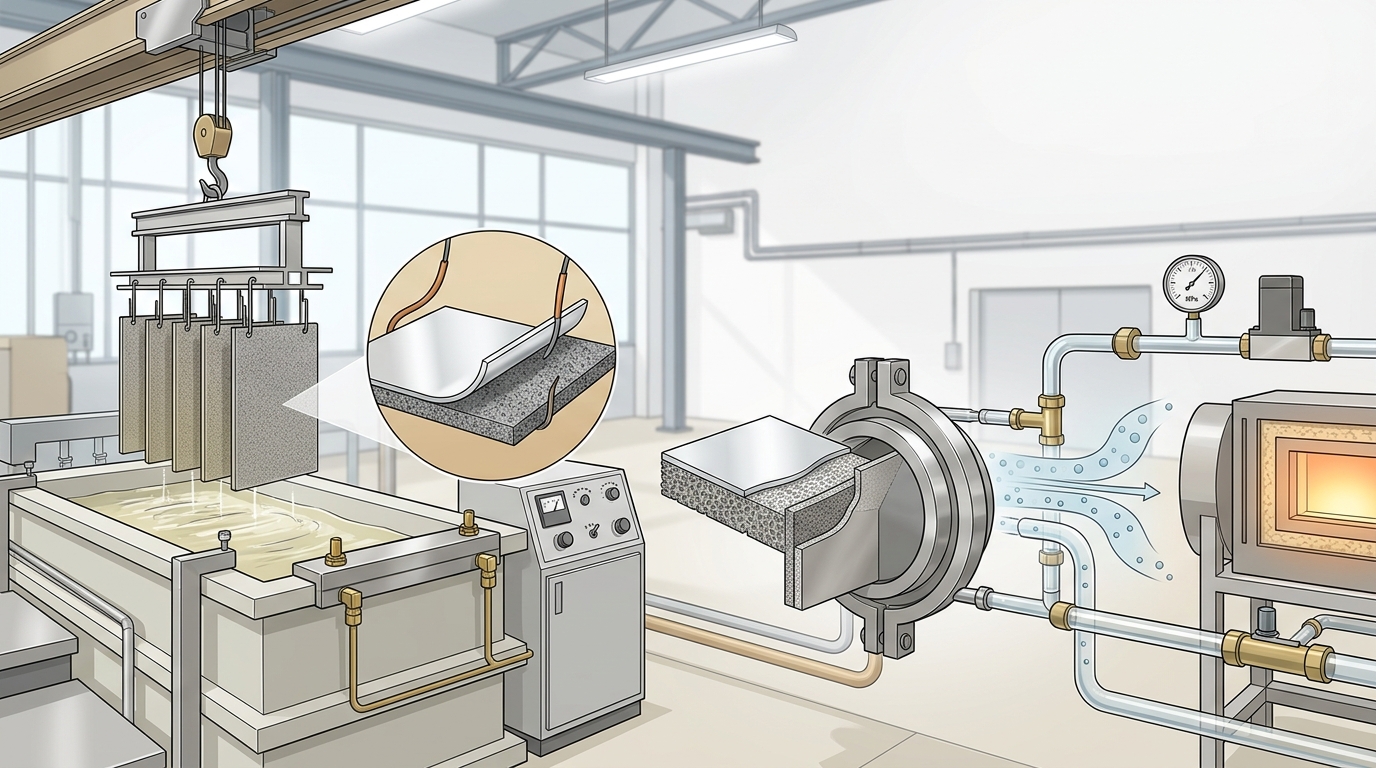
According to the release, the membrane integrates an about 1.5 µm Pd film with a porous Ni support, with both layers produced by electroplating. In the structure, the palladium provides hydrogen selectivity, while the porous nickel creates gas pathways and mechanically supports the thin film. AIST says this design makes it possible to combine lower palladium consumption with improved pressure resistance.
The described process starts with electroplating a dense palladium layer onto a smooth stainless-steel substrate. A porous nickel support is then electroplated on top of that layer, and the assembly is finally peeled from the substrate to obtain a free-standing composite membrane. AIST says the method offers controllability over thickness and deposited amount, and its sequential metal-forming approach could also lend itself to larger-area manufacturing by scaling substrate size and plating baths.
In the reported evaluation, a membrane using a porous nickel support with about 30% porosity showed no clear leakage in helium leak testing and maintained gas sealing. At 400 °C and a 0.75 MPa pressure difference, the membrane, with an effective diameter of 7.1 mm, delivered hydrogen flow above 150 cm3 per minute. The release contrasts this with a previously reported 5 µm single-layer pure Pd membrane of the same effective diameter, which did not withstand a 0.3 MPa pressure difference.
The researchers say the next step is to assess separation performance under more application-like conditions, including mixed gases, the effect of coexisting gases and long-term durability. AIST says the work could support lower-cost, higher-performance hydrogen purification units and membrane reactors. Technical details were published on September 2, 2026 in the International Journal of Hydrogen Energy.