Fraunhofer ISE in Freiburg, working with research and industry partners, has developed a new battery electrode architecture intended to increase stored energy without adding weight. According to the institute, the approach raises energy density by 10% to 15% by changing the internal structure of the electrodes, especially the thickness of their coatings.
The core idea is to make the electrode coating much thicker than in conventional designs. The team reports increasing the coating from a previously standard 100 to 200 micrometers up to 800 micrometers. That change reduces the number of current collectors needed inside the cell and leaves more space for active material. In practical terms, the concept shifts the internal balance of the cell toward energy-storing material rather than supporting conductive layers.
The architecture was first validated experimentally in small laboratory cells across three chemistries: lithium-ion, sodium-ion and zinc-ion. For lithium-ion batteries, the researchers also produced pouch-cell prototypes with the new electrode structure on a semi-automated production line in the cleanroom of Fraunhofer ISE’s Battery Materials and Cell Production Lab. The institute further states that the cell concept can be adapted to other chemistries as well.
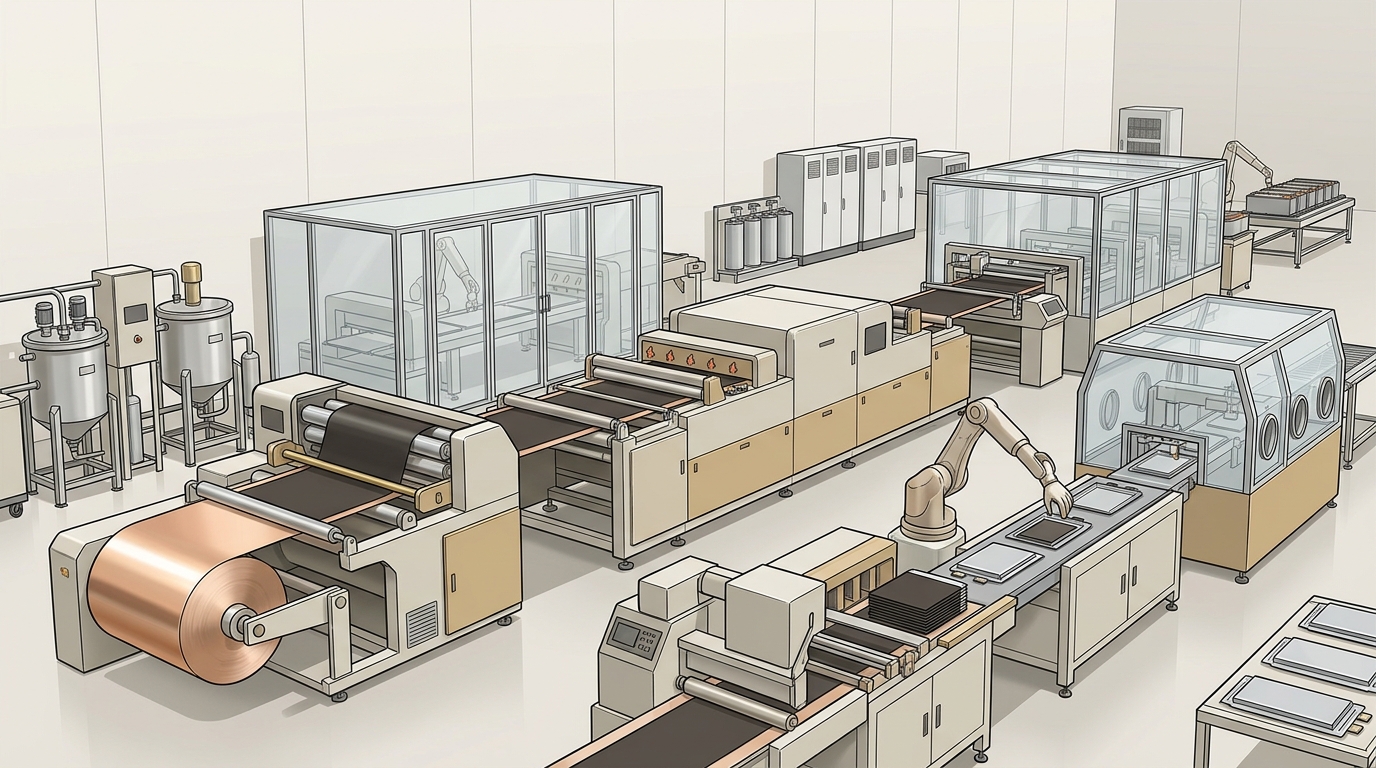
Manufacturing is another part of the proposal. Fraunhofer ISE describes the electrodes as PFAS-free and says no toxic solvents are required in production. It also argues that a potential production line for these electrodes would have significantly lower process complexity than a current wet-coating system. On that basis, the institute points to lower investment needs as well as lower operating costs through reduced space requirements and energy consumption.
On the industrialization side, Helmut Hechinger GmbH & Co. KG is part of the consortium as an industry partner contributing manufacturing expertise, while acp systems AG is developing the equipment for electrode production. Hechinger’s management says any move toward industrialization would depend on the outcome of the next scaling and validation steps, both in cost and performance terms. Fraunhofer ISE places the work in the broader context of growing demand for stationary storage in energy systems with a rising share of variable renewable generation.
The development spans several research projects: VORAN, which runs through June 2027, plus InFAB and WinZIB2, which have been completed. Other partners include the University of Stuttgart’s Institute for Photovoltaics and the Karlsruhe Institute of Technology/Helmholtz Institute Ulm. According to the source, VORAN and InFAB were funded by BMWE, while WinZIB2 received funding from BMBF.