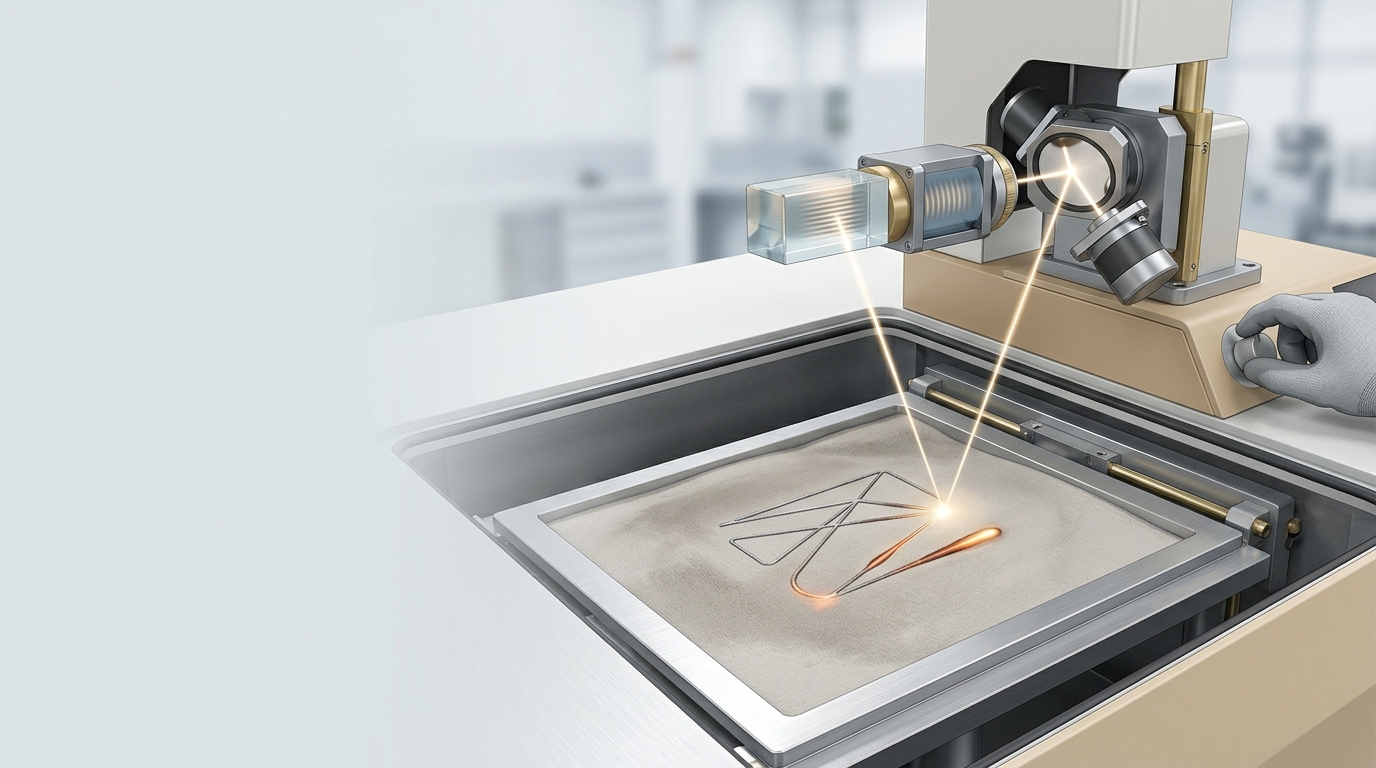
Galvanometer scanners remain the standard beam-steering technology in most industrial laser-based additive systems, from powder bed machines to resin platforms. Researchers are now studying whether acousto-optic deflectors, or AODs, can be added as a complementary element. The idea is not to replace the galvo, but to pair broad scan coverage with very fast, localized beam adjustments inside each scan path.
That interest comes from the galvo’s mechanical limits. Because the system relies on rotating mirrors, acceleration and deceleration restrict how quickly beam behavior can change in real time. An AOD works differently: a radio-frequency signal creates a temporary diffraction grating inside a crystal, which changes the outgoing beam direction. Depending on the device and spot size, beam position can shift in hundreds of nanoseconds, though over a much smaller angular range, cited as 5-20 mrad.
The article highlights two research programs that follow the same basic architecture. At the University of Texas at Austin, a stereolithography project uses two perpendicular AODs ahead of the galvo to rapidly widen the cured track without changing laser spot size. In simulation, compared with a similar galvo-only setup, the method projected a 60% reduction in the number of scans needed to cover a given area while maintaining the same dimensional accuracy. In 2025, the team also demonstrated the concept on a physical prototype and produced a 2D part with smoother diagonal edges through AOD-based track-width modulation.
A second effort, involving the Technical University of Munich and Trumpf, targets metal LPBF. In this case, the AOD does not continuously sweep the beam. Instead, it rapidly hops the beam between discrete positions during galvo motion. If switching is fast enough, the melt pool responds to the time-averaged intensity distribution rather than each individual dwell point. That allows software-driven synthesis of ring, elliptical, top-hat and other custom beam profiles downstream of the laser source.
According to the article, such a hybrid scan head could eventually enable region-specific beam behavior within a single layer: a finer effective spot near part edges, a wider effective track in bulk sections, and faster adaptation in geometrically sensitive areas such as thin walls, corners and feature-to-bulk transitions. On the power side, the text notes that commercial tellurium dioxide AODs similar to those used in the TUM/Trumpf work are engineered for continuous-wave operation at 1064 nm with kilowatt-class lasers, covering a substantial share of current metal LPBF systems, while configurations above 1 kW present added challenges.
The underlying concept therefore appears technically credible in research settings and in adjacent laser-processing applications, but it has not yet been fully integrated into a production commercial 3D printer. Open engineering questions include scaling CW power, integration with melt-pool monitoring, and cost-versus-complexity tradeoffs relative to other beam-control methods. The article also points to ScanLab’s 2025 presentation on cascaded galvo/AOD scan systems, including work with Fraunhofer ILT on dynamic beam shaping for LPBF, suggesting that the topic is moving from laboratory exploration toward practical engineering development.